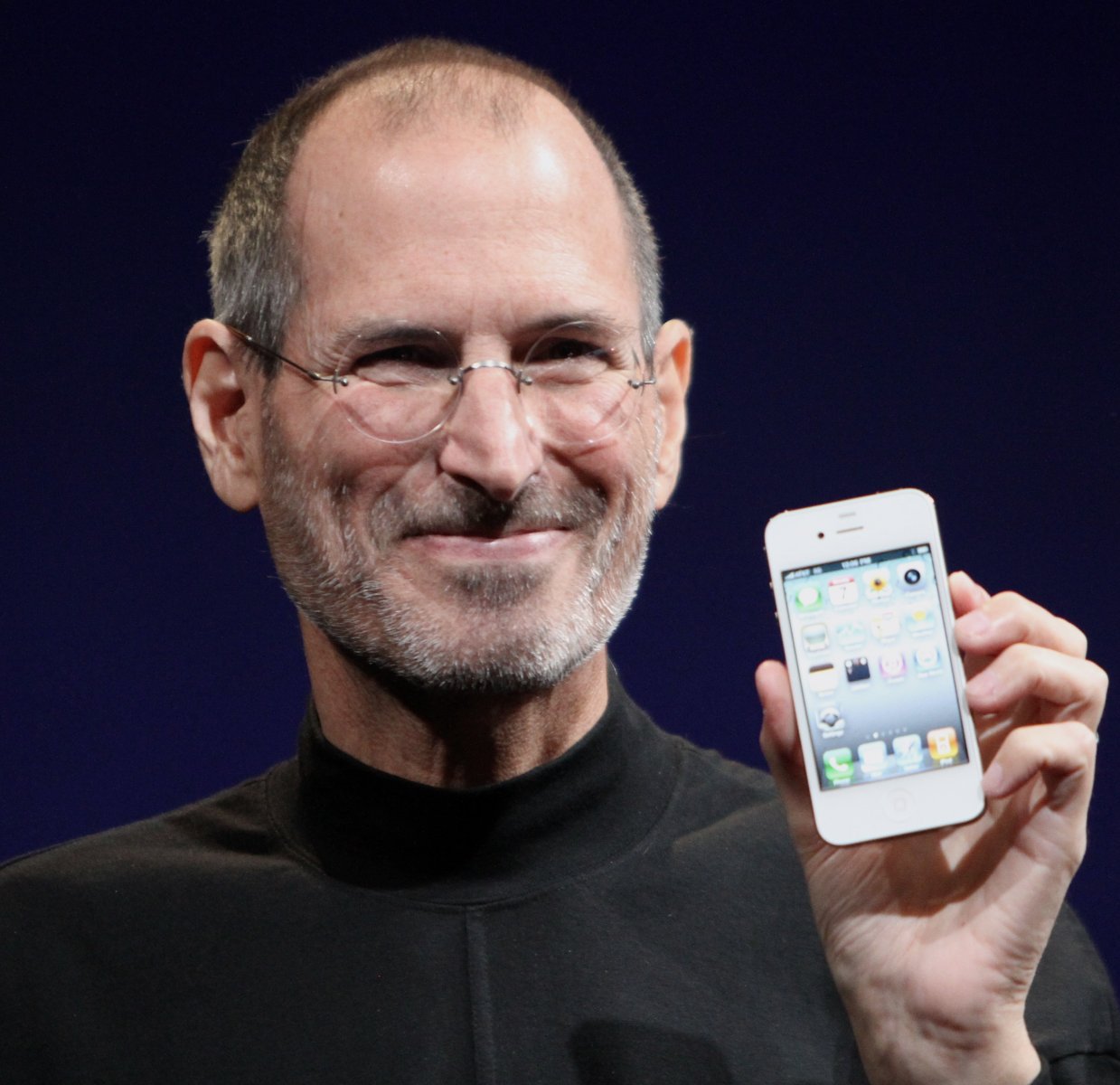
Jobs was born in San Francisco in 1955 and adopted shortly afterwards. He attended Reed College in 1972 before withdrawing that same year. In 1974, he travelled through India, seeking enlightenment before later studying Zen Buddhism. He and Wozniak co-founded Apple in 1976 to further develop and sell Wozniak's Apple I personal computer. Together, the duo gained fame and wealth a year later with the production and sale of the Apple II, one of the first highly successful mass-produced microcomputers.
Steven Paul Jobs (February 24, 1955 – October 5, 2011) was an American businessman, inventor, and investor. A pioneer of the personal computer revolution of the 1970s and 1980s, Jobs co-founded Apple Inc. (as Apple Computer Company) with his early business partner Steve Wozniak in 1976. After the company's board of directors fired him in 1985, he founded NeXT the same year and purchased Pixar in 1986, becoming its chairman and majority shareholder until 2007. Jobs returned to Apple in 1997 as CEO, where he was closely involved with the creation and promotion of many of the company's most influential products until his resignation in 2011.
Jobs was born in San Francisco in 1955 and adopted shortly afterwards. He attended Reed College in 1972 before withdrawing that same year. In 1974, he travelled through India, seeking enlightenment before later studying Zen Buddhism. He and Wozniak co-founded Apple in 1976 to further develop and sell Wozniak's Apple I personal computer. Together, the duo gained fame and wealth a year later with the production and sale of the Apple II, one of the first highly successful mass-produced microcomputers.
Jobs saw the commercial potential of the Xerox Alto in 1979, which was mouse-driven and had a graphical user interface (GUI). This led to the development of the largely unsuccessful Apple Lisa in 1983, followed by the breakthrough Macintosh 128K in 1984, the first mass-produced computer with a GUI. The Macintosh launched the desktop publishing industry in 1985 (for example, the Aldus PageMaker) with the addition of the Apple LaserWriter, the first laser printer to feature vector graphics and PostScript.
In 1985, Jobs departed Apple after a long power struggle with the company's board and its then-CEO, John Sculley. That same year, Jobs took some Apple employees with him to found NeXT. This computer platform development company, of which the CEO is also a specialist in computers for higher-education and business markets. In 1986, he bought the computer graphics division of Lucasfilm, which was spun off independently as Pixar. Pixar produced the first computer-animated feature film, Toy Story (1995), and became a leading animation studio, producing dozens of commercially successful and critically acclaimed films.
In 1997, Jobs returned to Apple as CEO after the company acquired NeXT. He was largely responsible for reviving Apple, which was on the verge of bankruptcy. He worked closely with British designer Jony Ive to develop a line of products and services that had larger cultural ramifications, beginning with the "Think different" advertising campaign, and leading to the iMac, iTunes, Mac OS X, Apple Store, iPod, iTunes Store, iPhone, App Store, and iPad. Jobs was also a member of the board of directors at Gap Inc. from 1999 to 2002. In 2003, Jobs was diagnosed with a pancreatic neuroendocrine tumour. He died of tumour-related respiratory arrest in 2011; in 2022, he was posthumously awarded the Presidential Medal of Freedom. Since his death, he has won 141 patents; Jobs holds over 450 patents in total.