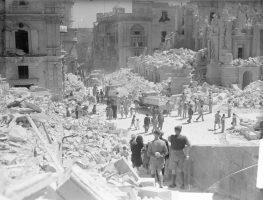
Before World War II, Valletta was the location of the Royal Navy's Mediterranean Fleet's headquarters. However, despite Winston Churchill's objections, the command was moved to Alexandria, Egypt, in April 1937 fearing it was too susceptible to air attacks from Europe. At the time of the Italian declaration of war (10 June 1940), Malta had a garrison of less than four thousand soldiers and about five weeks of food supplies for the population of about three hundred thousand. In addition, Malta's air defences consisted of about forty-two anti-aircraft guns (thirty-four "heavy" and eight "light") and four Gloster Gladiators, for which three pilots were available.
Read full story →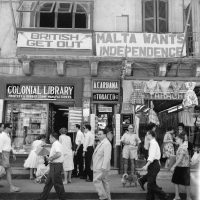
After the Second World War, the islands achieved self-rule, with the Malta Labour Party (MLP) of Dom Mintoff seeking either full integration with the UK or else "self-determination" (independence) and the Partit Nazzjonalista (PN) of George Borg Olivier favouring independence, with the same "dominion status" that Canada, Australia and New Zealand enjoyed.
Read full story →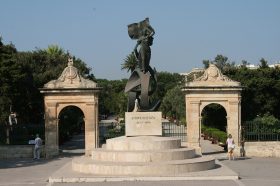
Malta gained independence from Britain on 21 September 1964, becoming a sovereign nation while remaining within the Commonwealth.
Read full story →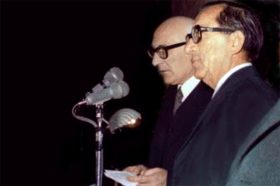
The elections of 1971 saw the Labour Party (MLP) under Dom Mintoff win by just over 4,000 votes. The Labour government immediately set out to re-negotiate the post-Independence military and financial agreements with the United Kingdom. The government also undertook nationalization programmes and the expansion of the public sector and the welfare state. Employment laws were updated with gender equality being introduced in salary pay. Concerning civil law, civil marriage was introduced and homosexuality and adultery were decriminalised (1973); capital punishment for murder was abolished in 1971. The following year, Malta entered into a Military Base Agreement with the United Kingdom and other NATO countries, after mediation by Italy's Aldo Moro.
Read full story →
On 1 April 1979 the last British forces left the island after the end of the economic pact to stabilise the Maltese economy. This is celebrated as Freedom Day (Jum Il-Ħelsien) on 31 March. Celebrations start with a ceremony in Floriana near the War Memorial. A popular event on this memorable day is the traditional regatta. The regatta is held at the Grand Harbour and the teams taking part in it give it their best shot to win the much coveted aggregate Regatta Shield.
Read full story →